

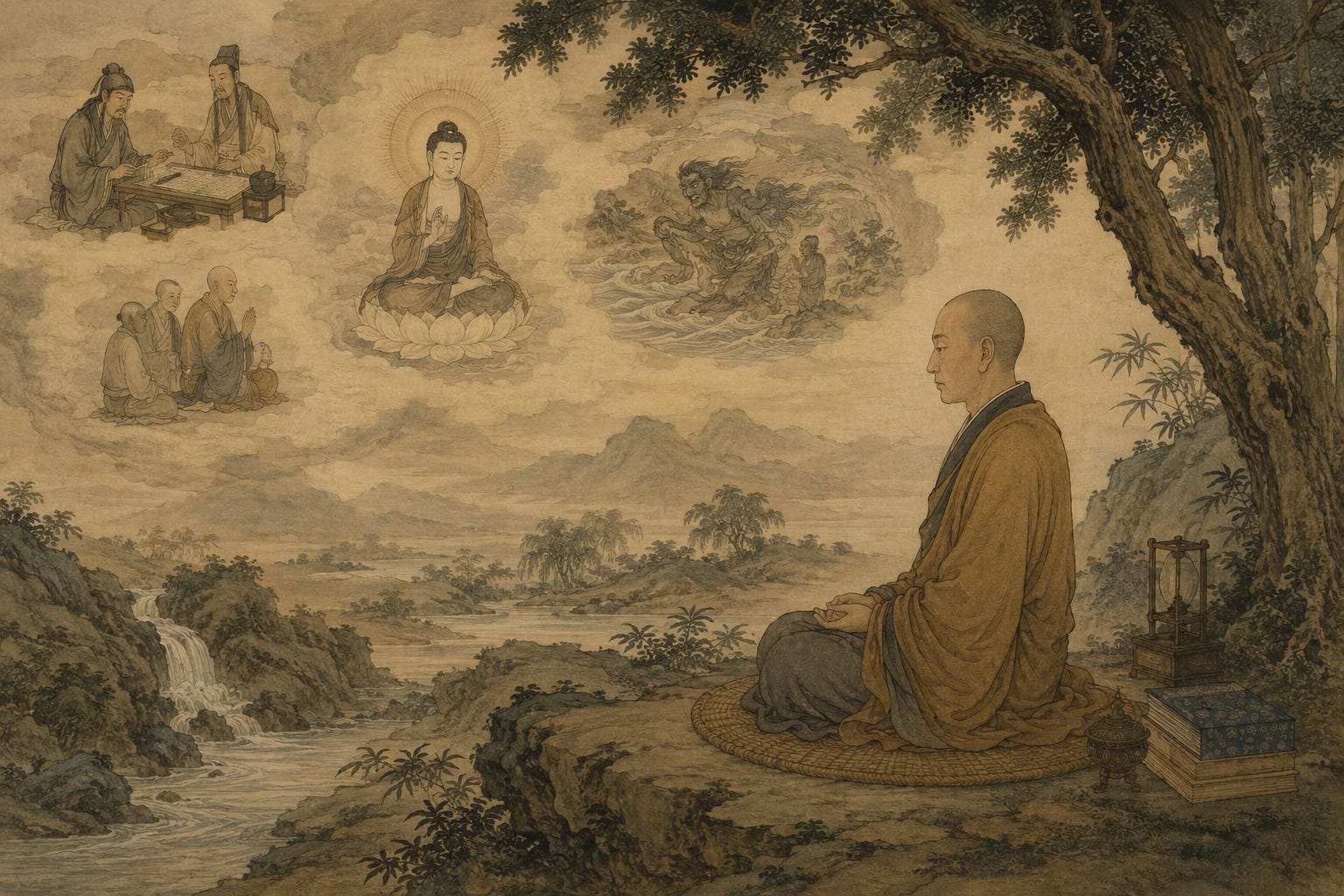
Ninety years ago, one of the great forefathers of academic Buddhology, the French scholar Paul Demiéville (1894–1979), summarized the health-related ideas and practices found in the medieval Chinese Buddhist canon. Demiéville said he found it “easy to discern” that there were three distinct types of approaches to healing in the sources, which he called “properly medical,” “religious,” and “magical.”1 Although he noted that the boundaries between these three were “far from neat,”2 he nonetheless applied these categories as the central organizational structure of his essay, which went on to become the most widely cited scholarly treatment of Buddhist medicine up until the 2020s.3 According to this tripartite organizational scheme, “properly medical therapeutics” included Buddhist references to classical Indian medicine, surgeries both major and minor, as well as a range of pharmacological remedies. The “religious” types of healing included all varieties of meditation, contemplation, and devotional activities involving deities and scriptures. “Magical” techniques consisted largely of incantations and rituals.
These three categories seemed natural or self-evident in the first half of the twentieth century. But categories are never universal or natural divisions of human practice; they are always historical constructs that reflect particular cultural and intellectual developments. Just how applicable are the categories of medicine, religion, and magic to medieval Chinese Buddhist ways of knowing? As a case study, let’s examine how well these three categories apply to one of the most important pieces of writing on Buddhist medicine from the time period: a treatise on healing meditations by Zhiyi 智顗 (538–597), a patriarch of the influential Tiantai (Jp. Tendai) school.
As a systematizer of Chinese Buddhism, Zhiyi had a particularly encyclopedic grasp on meditation techniques, and was enthusiastic about incorporating knowledge from various different types of sources into his practice framework. From 575 to 585, Zhiyi took up residence on Mt Tiantai 天台山 for intensive study and practice. During this time, he developed a highly influential approach to healing using meditation that would become formative for later Buddhist traditions all over East Asia.4 Zhiyi continued lecturing on meditative healing as he got older, and late in his life his disciple Guanding (561–632) wrote down the definitive statement of his ideas in the Greater [Treatise on] Śamatha and Vipaśyanā Meditation (Mohe zhiguan 摩訶止觀).5 Completed in 594, this text contains a chapter called “Contemplating the Condition of Being Stricken with Illness” (Guanbing huanjing 觀病患境) that summarizes Zhiyi’s approach to healing with meditation.
If we are looking for the tripartite distinction, we can indeed see Zhiyi teasing out three distinct kinds of healing practice that roughly parallel Demiéville’s categories:
1. Conventional medicine. Throughout his chapter on illness, Zhiyi draws on concepts and practices that belong to medical contexts outside of Buddhist doctrinal and social circles. On several occasions, he explicitly refers to “the methods of the physicians” (yifang 醫方) and the knowledge of “specialists in healing the body” (tizhijia 體治家).6 His chapter draws on both Indian and Chinese medical knowledge, introducing diagnostic and therapeutic recommendations drawn from both traditions.7 Zhiyi uses the mainstream language of Chinese medicine—terms such as yin-yang 陰陽, qi 氣, the Five Phases (wuxing 五行), the Five Viscera (wuzang 五臟)—throughout in his discussion of symptoms, diagnosis, disease causation, and treatment options. The Indian medical concepts of the Four Elements (Skt. mahābhūta; i.e., earth, water, fire, and wind) are equally widespread in his treatise.
2. Buddhist perspectives. Despite the positive characterization of medical knowledge, Zhiyi is most interested in arguing for the healing efficacy of Buddhist methods. He considers illness to be one of the principal obstacles to practicing the Dharma, but also notes that being sick is an opportunity to reflect on one’s lack of karmic merit, to recommit to proper moral behavior, and to investigate more deeply the nature of the mind and body. Citing the Vimalakīrti Sūtra and Mahāparinirvāṇa Sūtra, Zhiyi presents illnesses as being ultimately illusory: they arise from delusion, wrong views, and attachment to a physical body that is not ontologically real. Knowledge of Buddhist doctrines such as the Four Noble Truths, Dependent Origination, and the Six Perfections, he suggests, leads one toward the ultimate truth that the body and all of its travails are ultimately empty. If only one is able to realize the empty nature of all phenomena, illnesses will fall away spontaneously.
Predictably, given the focus of the treatise, Zhiyi advances the practice of meditation as the key to achieving this realization. He also prescribes a number of concentration (Ch. zhi 止; Skt. śamatha) and contemplation (Ch. guan 觀; Skt. vipaśyanā) techniques in order to manage specific types of symptoms. Practicing these meditations with the right intention and motivation, he says, is the “Great Medicine” (dayao 大藥).
In one passage, Zhiyi establishes his own four-fold typology of diseases: (1) illnesses caused by lifestyle factors such as work, food, and drink, (2) those caused by unregulated meditation, (3) those caused by demons or Māra (i.e., spirit-caused physical or mental/ethical ailments), and (4) those caused by karma. The conventional medicines of the physicians, Zhiyi suggests, should only be used to treat the first category, while Buddhist meditation is useful in treating all of the other three.8
However, meditation is not the only effective Buddhist therapy. In the case of illness caused by unregulated meditation, it is only meditation that can provide relief. “Great spirit-spells” (Ch. dashenzhou 大神呪; Skt. mantra, dhāraṇī) will also work for illnesses caused by demons or Māra, and confession and repentance will also work for illnesses that have karmic origins. Here Zhiyi warns several times against using physicians’ methods for treating these categories of ailment, which necessitate Dharmic interventions.
3. “Methods and arts.” Zhiyi mentions a third type of healing techniques in his treatise, fangshu 方術, that is reminiscent of the modern category of magic. Traditionally in China, this term referred to various healing, mantic, divinatory, and calendrical techniques and skills that were widespread and that were practiced by a variety of popular healers, technicians, and popular ritual specialists of relatively low status. Like the modern Western commentators who sneered at the superstitions of the popular masses, Zhiyi makes clear his negative opinion of such practices:
These techniques are shallow and common, and are often based on illusions. They should not be used by home-departed ones (i.e., the Buddhist sangha). Basically, they need not be studied, and if they have been studied, should be quickly rejected.9
As examples of such techniques, Zhiyi mentions “methods for healing hiccups, methods for fixing toothaches, healing the liver by twisting the thumbs, and so forth.” He details a Sanskrit spell to protect against the baleful astrological forces of the “thirty-six types of beasts” (sanshiliu shou 三十六獸), troubling spirits and oppressive qi.10 He goes on to briefly relate various other incantations, certain ways of holding or controlling the breath, and the practice of “twisting the dantian with your hand until it hurts.” He explains that this latter technique works because the pain distracts one from creating “extraneous conceptions” (hengxiang 横想), the uncontrolled mental proliferations that cause disease.
The Buddhist conceptual underpinnings of this latter technique, the mention of breath control, and the presence of Sanskrit incantations among the list of “methods and arts” suggest that Zhiyi is not using the term fangshu as a blanket indictment of non-Buddhist practices. Rather, he seems primarily to be using it as an umbrella term for techniques that he considers to be vulgar, plebeian, or overly simplistic. Zhiyi’s statement that such techniques are based on illusions or hallucinations (huan 幻) also sets them apart from the therapies presented elsewhere in the treatise, marking them as dubious and untrustworthy.
Yet, while they are suspect, fangshu techniques can also be potentially beneficial insofar as they prevent illness from derailing one’s progress on the path to enlightenment. Zhiyi makes it clear that the primarily problem is not that they are not useful, but that there is a danger of abuse:
If (these divination techniques) can be borrowed and used to heal diseases, it may make it easier to stay on the path (of practice to awakening), so you should not despise them. However, if they are used to invite fame or to gain profit, and thus provoke or stir up the worldly people of the times, this is a delusion and farce of Māra and should be quickly rejected, (I repeat,) quickly rejected.11
While one should thus be cautious in taking up fangshu practices that potentially might lead one astray, it is nevertheless entirely possible to incorporate such techniques into one’s repertoire of skillful means.
So, are “medicine,“ “religion,” and “magic” useful glosses for the categories presented in Zhiyi’s treatise? There indeed are some parallels, but also some important differences. In Western tradition, medicine, religion, and magic were understood to be mutually antagonistic bodies of knowledge that competed for authority and legitimacy. In contrast, Zhiyi’s boundaries are more fluid. As a Buddhist monastic, Zhiyi was most interested in arguing for the efficacy of the meditations and other interventions that were the specialized domain of his monastic order. But, while he established a hierarchy with Dharmic approaches at the top, he remained enthusiastic about the usefulness of conventional medicine for the diagnosis and treatment of specific kinds of illness, and reluctantly willing to even consider the practical value of folk practices.
Another difference between the two is that, whereas the Western categories are epistemological, Zhiyi’s primary concern was soteriological. While Western discourses, at least in Demiéville’s time, considered approaches associated with empiricism and rationality to be the most legitimate, the sixth-century patriarch ranked practices according to their usefulness in supporting the process of liberation.
What’s the takeaway point of this comparison? I’ll leave you with this irony: Zhiyi, one of the greatest Buddhist thinkers of the medieval period, imposed a culturally and historically specific hierarchy onto Buddhist texts in pursuit of his systematizing agenda. But, Demiéville was doing the exact same thing. Each scholar, it turns out, organized and rated the same material in order to make sense of them by fitting them into the logics of his own world. The parallels we see between medieval and modern categories thus may be compelling, but the differences in their underlying assumptions are even more significant. The culturally dependent nature of categories should inspire us to wield them with humility, however natural or self-evident they may seem to us at the time.
References
Demiéville, Paul. 1985 [1937]. Buddhism and Healing: Demiéville’s Article ‘Byō’ from Hōbōgirin. Translated by Mark Tatz. Lanham, Md.: University Press of America.
Swanson, Paul L. 2026. “Healing Disease with Meditation: ‘Contemplating the Objects of Disease’ from Zhiy’s Great Treatise.” In C. Pierce. Salguero (ed.), Meditation Sickness: An Anthology on the Dangers of Meditation Practice, 87–107. Honolulu: University of Hawaii Press.
Salguero, C. Pierce. 2017. “Healing with Meditation: ‘Treating Illness’ from Zhiyi’s Shorter Treatise on Śamatha and Vipaśyanā.” In C. Pierce. Salguero (ed.), Buddhism & Medicine: An Anthology of Premodern Sources, 382–89. New York: Columbia University Press.
Salguero, C. Pierce. 2015. “Reexamining the Categories and Canons of Chinese Buddhist Healing,” Journal of Chinese Buddhist Studies 28: 35–66.
Salguero, C. Pierce. 2014. Translating Buddhist Medicine in Medieval China. Philadelphia: University of Pennsylvania Press.

Notes
1 Demiéville 1985 [1937]: 82.
2 Demiéville 1985 [1937]: 83.
3 Elsewhere, I have described this essay as a masterful example of scholarly erudition, although it betrays a modernist bias in multiple places (see Salguero 2015: 51–55).
4 These early formulations of Zhiyi’s ideas can be found in T. 1915.9 and T. 1916.6.4. The former is translated in Salguero 2017.
5 Here I have referenced Paul Swanson’s translation, which I edited and reproduced in Swanson 2026.
6 In Buddhist texts, yi 醫 — the Chinese term most often translated into English as “medicine” — was a social rather than epistemological designation. That is to say, we should usually translate this character not as “medicine” but as “physician.”
7 I have discussed Zhiyi’s bicultural medical synthesis in more detail in Salguero 2017.
8 Swanson 2026: 98–99.
9 Swanson 2026: 105.
10 The beasts are nefarious influences associated with different times of day.
11 Swanson 2026: 105.
Gracias Pierce.
I am not entirely clear on the difference between a Dharmic interventions and a Divinatory (etc.) techniques other than the first is performed by a Buddhist and the other by a lower level popular healer - I see the difference in the social roles but wonder if they both might be considered as faith based healings? The similarity is curious to me because at first it seems that Zhiyi is separating by physical and spirit level illnesses, but classifications 2 and 3 appear to both fall under spirit level while the first is physical. Or perhaps 2 is more mental/emotional and 3 is spirit level?
The other aspect that caught my attention was the ontological perspective. While illnesses are physical phenomena that occur, it seems important to understand the cause of the illness to address the correct treatment. This assessment then classifies the type of illness and hence the necessary treatment. But then to say it is all emptiness can undermine everything and simultaneously solve everything. Is this then implying that healing is enlightenment?
(This does to some extent parallel the Ling Shu with its premise that all illness is rooted in the spirit. The difference may be that the meridian pathways in acupuncture serves as a kind of alchemical process that negotiates heavenly/karmic qi and corporeal qi - which makes the body an evolving conduit for spiritual experience and physical manifestation. The Buddhist interpretation seems more instantaneous and direct b/w spirit and physical?)